I got to the plant sale twenty minutes after it opened, and the mountain mint was already down to a single flat. A woman in a wide straw hat was holding two pots of it and looking at me as if I might try to take them. I picked four from what was left and kept moving.
It was a spring native plant sale, folding tables in rows on a parking lot, every plant in a small square plug pot with a handwritten label stuck in the soil. Plugs were $3.50 each. I came home with eighteen, $63 in all, in a cardboard flat that made the whole Forester smell like wet soil.
What I bought
- 4 mountain mint
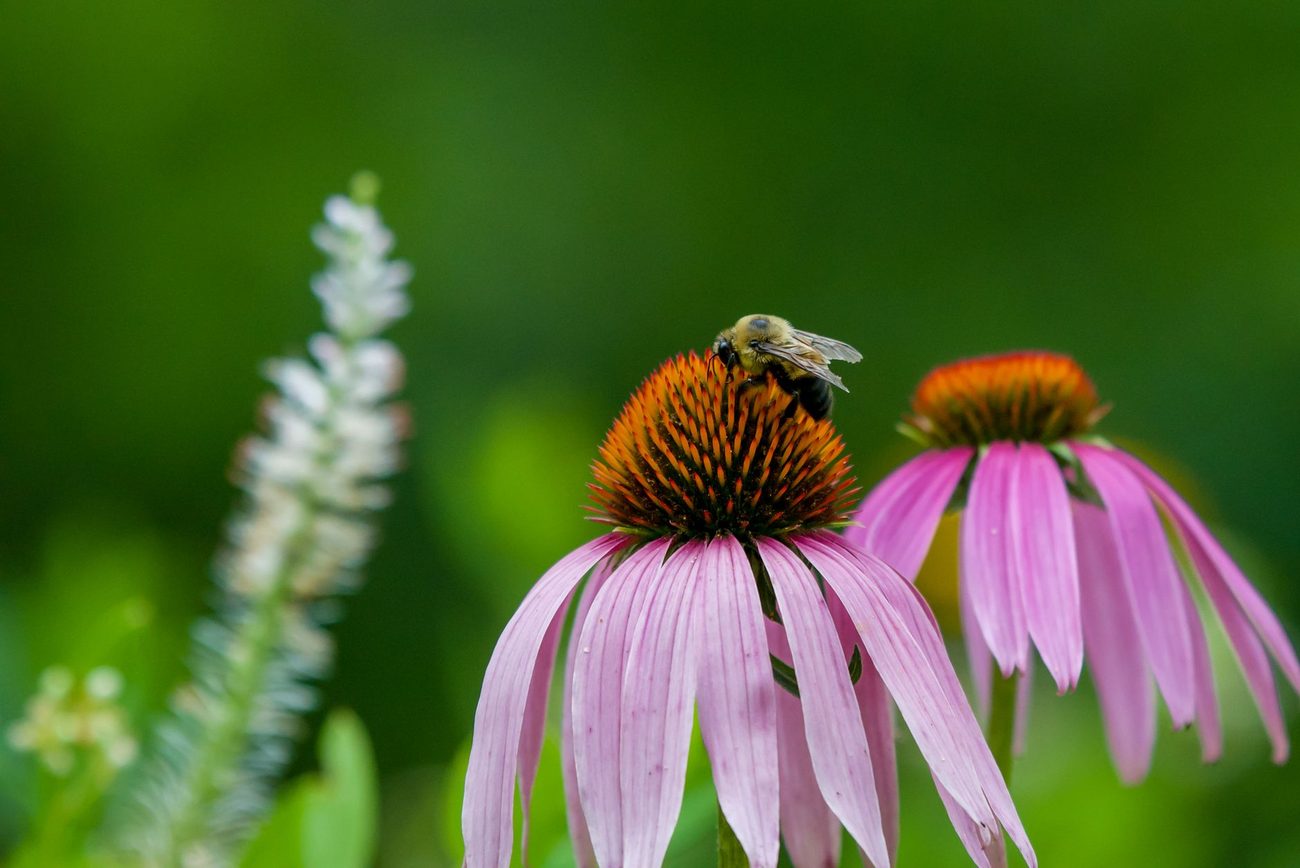
- 4 purple coneflower
- 4 black-eyed Susan
- 3 New England aster
- 3 anise hyssop
I chose plants that bloom at different times, so something should be open from July into October. Black-eyed Susans and coneflowers carry midsummer, anise hyssop and mountain mint overlap them, and the asters finish the year when almost nothing else is blooming. Mountain mint was the one I wanted most. Every native plant person I've ever talked to says it's covered in insects all summer, and I want to see that with my own eyes. The anise hyssop leaves smell like black licorice when you brush them, which Mateo discovered in the car and announced every few minutes until we got home.
The strip
Along the back of the yard runs our 6-foot stockade fence, gray and a little crooked. For years there's been a strip at its base where grass never really grew, about 18 inches deep, scuffed bare by the mower and buried in leaves every fall. It gets sun from mid-morning into the early afternoon, around six hours in summer, about the same light as the raised beds.
On Friday evening I cut out the scraggly grass with a flat spade, flipped the clumps upside down in place and covered them with two inches of compost. This morning I planted. The taller plants went in back against the boards, the asters and anise hyssop, with the coneflowers and black-eyed Susans in front where they won't get hidden. Mountain mint spreads by runners, so I gave it the end of the strip farthest from the rhubarb, where it can roam without crowding anything we eat.
I spaced them about a foot apart in a loose zigzag. That will look sparse this summer, and that's fine. The old saying about perennials is that the first year they sleep, the second year they creep and the third year they leap. I'm planting for the third year.
Each plug went in with the hori-hori, a little deeper than its pot, and got watered in with the galvanized can. The finished strip looks like a row of green commas against the gray boards. You have to know it's there to see it.
A small contradiction
Last weekend I raked every bit of leaf litter out of this same fence line because of ticks. This weekend I planted a strip of natives, and native plants and the insects that use them generally like leaves left on the ground. I'm doing both, imperfectly. The strip gets a thin layer of shredded leaves as mulch, enough to hold moisture and feed the soil, but not the deep, damp pile that used to sit there all summer. The tick tubes are still out along the fence. If it turns out those two goals can't share 18 inches of dirt, I'll find out the honest way and write it down.
Watering and waiting
New plugs need water every couple of days for the first month, then less, and by next summer they should mostly fend for themselves. Rain is in the forecast for Monday, which saves me a few trips with the can. Not much will bloom this year beyond maybe the black-eyed Susans and a coneflower or two, and the asters won't flower until September, if they flower at all in their first season.
I'm also expecting losses. Plugs are small, and a strip along a fence is where digging squirrels, a careless mower wheel and plain bad luck find them first. If fourteen of the eighteen are alive next June, I'll call it a success and fill the gaps from whatever spreads.
Mateo came out while I was watering and asked when the bees would show up. I said August, maybe. He looked at the eighteen little plants, then at me, and said, "That's a lot of waiting for sixty-three dollars." He's ten. He isn't wrong.